Why More Drilling Wouldn’t Shield U.S. Consumers
More U.S. drilling might have softened a global oil shock, but it wouldn’t have insulated American consumers. The distinction is between influencing the supply available to the market and controlling the price consumers pay. Oil is traded across borders, so a disruption that affects global supply can move prices even when domestic production remains strong. More production could add a cushion; it can’t make U.S. prices independent of events that affect the wider market.
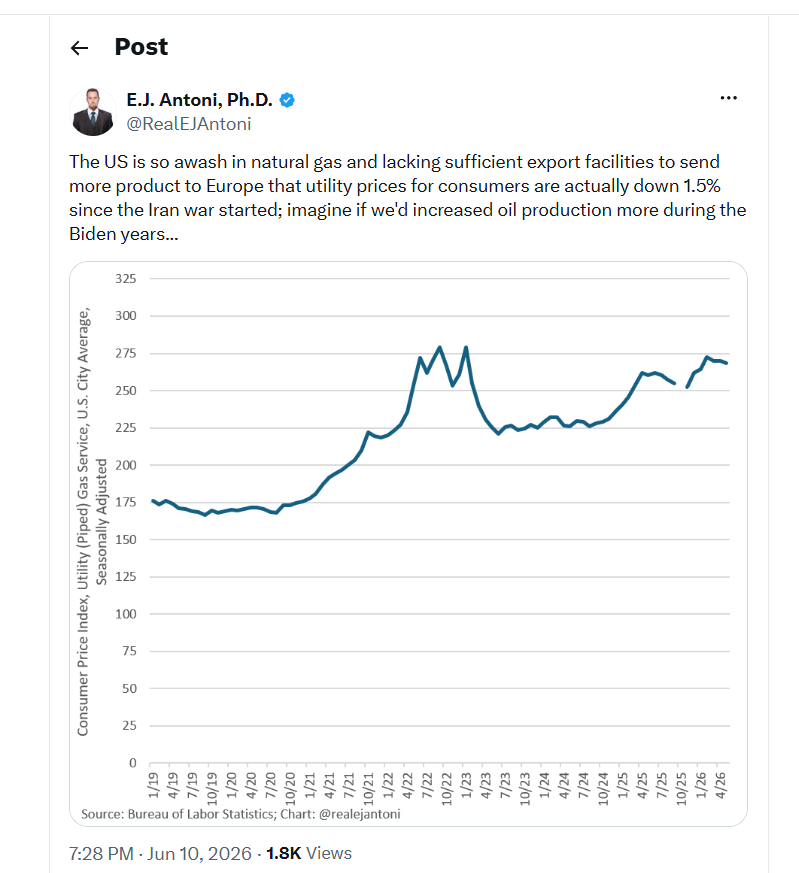
That’s the central point in the comparison EJ Antoni, chief economist at the Heritage Foundation, has made about natural gas: domestic supply conditions don’t fully determine prices when a commodity is traded internationally. The degree of connection depends on how easily supply can move between markets. Where export capacity is limited, domestic prices may be less directly exposed to foreign demand; where exports can respond, local conditions can become more closely linked to global ones. The analogy helps explain why production alone doesn’t settle the question of household costs.
Production, Exports and the Price Consumers Face
Oil production and oil prices are related, but the relationship isn’t a simple one-to-one calculation. A country can produce more and still experience higher prices if a global disruption makes available supply scarcer or buyers compete more intensely for it. Additional domestic output may limit the size of a price increase by adding barrels to the pool of supply. Whether it does so, and by how much, depends on the scale and reach of the disruption.
Export capacity is one channel through which domestic and international markets connect. When producers can send more of a commodity abroad, foreign demand can influence the price that domestic suppliers can obtain. That connection doesn’t mean every unit produced is exported or that domestic prices instantly match prices elsewhere; transport, infrastructure, and market conditions matter. It does mean that a larger domestic supply base, by itself, isn’t a guarantee that U.S. households will be spared a global price shock.
Oil and natural gas aren’t interchangeable, and the natural-gas comparison has limits. Their transport systems, uses, and market structures differ. Still, Antoni’s point about export capacity illustrates a broader economic mechanism: a commodity’s domestic price can reflect both local supply and the conditions governing trade with other markets. The relevant question isn’t only how much is produced, but also how connected that supply is to global buyers.
Household Exposure Depends on What People Use
The article’s second counterfactual shifts attention from the supply of oil to the demand households have for it. If more drivers used electric vehicles, households would have less direct exposure to gasoline prices. That wouldn’t prevent oil prices from rising, and it wouldn’t erase every effect of a fuel shock on the economy. It could, however, reduce the amount of that increase that passes straight through to some household budgets.
This is more significant than it looks. A price shock matters to consumers not just because the price changes, but because of how much of the affected product they need to buy and how easily they can change that amount. For a household that relies on a gasoline-powered vehicle, higher fuel costs can leave less money available for other spending. A vehicle fleet with a greater electric share could change that exposure, though the extent would depend on how many households had switched and how they used their vehicles.
Keeping or expanding incentives for electric vehicles is presented here as a way that policy could have influenced that longer-term exposure. The argument is about the composition of the vehicle fleet and the household costs associated with fuel, not a claim that incentives would have prevented a global oil shock. Incentives may affect the decision to buy a vehicle, but the resulting change in fuel use would unfold as the fleet changed. Not an immediate shield.
If you’re working in this space, the distinction matters: production policy and vehicle policy address different parts of the same vulnerability. Domestic drilling can affect how much supply is available. Vehicle choices affect how much gasoline consumers need. Neither one, on its own, determines the full price households face during a global disruption.
Where the Counterfactual Ends
The source points to a more direct way to avoid this particular shock: preventing the war and Iran’s leverage over the Strait of Hormuz. That statement identifies the geopolitical source of the risk described in the article. It doesn’t establish what would have happened under any specific alternative, or how much a different mix of U.S. production and vehicles would have changed prices.
That said, the counterfactuals help separate three questions that can get blurred in public debate: what causes a global oil shock, what domestic production can do to affect its severity, and how much of the price change reaches consumers. A country’s production can matter without giving it control over global prices. A household’s dependence on gasoline can matter even when it has no influence over the events that moved those prices.
What this means for you is that energy security can’t be assessed by drilling levels alone. The source’s argument points to both exposure to international markets and the structure of household energy use. More domestic output might have softened the shock, while a less gasoline-dependent vehicle fleet might have reduced some household costs. Those are separate channels, and neither changes the source’s central claim about the war and the Strait of Hormuz.