How the financing mix is changing
The financing mix behind AI investment is changing. Hyperscalers have relied heavily on cash generated by their businesses to fund investment, but they're beginning to turn to external funding as spending needs grow. That shift gives bond yields a more direct path into decisions about how much infrastructure they build. The change doesn't show that investment will fall; it means the cost and availability of financing may matter more than they did when internal cash covered the bill.
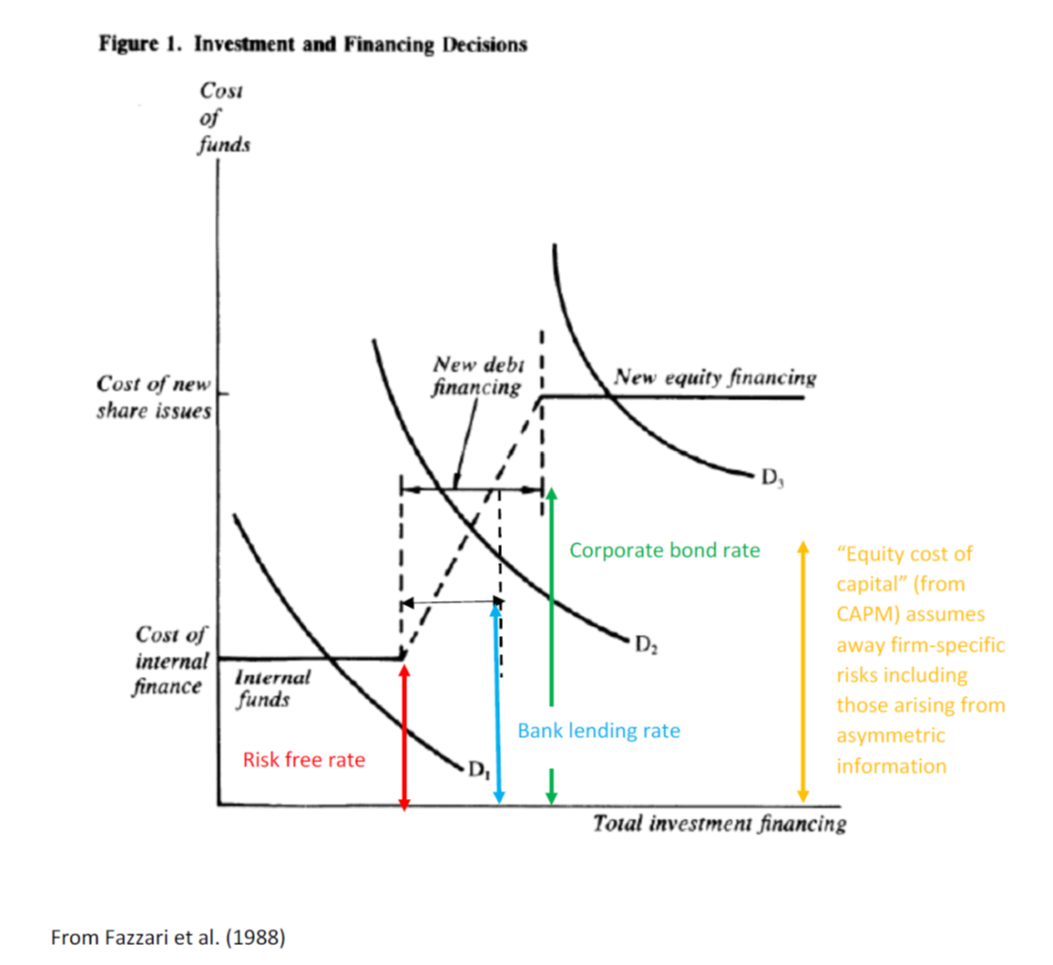
Source: Fazzari et al. (1988), as modified by Chinn.
The graph’s flat lower section represents investment funded from cash flow: within that range, a company can increase investment without needing to seek more expensive outside finance. Until recently, the source’s account says, hyperscaler investment demand met the supply of finance on this flatter portion. From 2026, hyperscalers have begun relying on external funding, while other AI firms without cash flow had already been doing so for months. In the graph’s terms, demand has shifted outward, bringing the cost of finance into sharper focus.
This distinction helps explain why the financing mix can affect investment even when companies remain committed to AI. Cash flow is generated inside the business; borrowing connects spending plans to lenders and bond markets. External funding can support projects that exceed available internal funds, but it also exposes those plans to financing conditions. Here's the thing: an outward shift in demand for funds doesn't itself tell us how much investment will be completed. It says that more finance is being sought at a time when the price of that finance may influence which plans proceed.
What the charts show about borrowing and spending
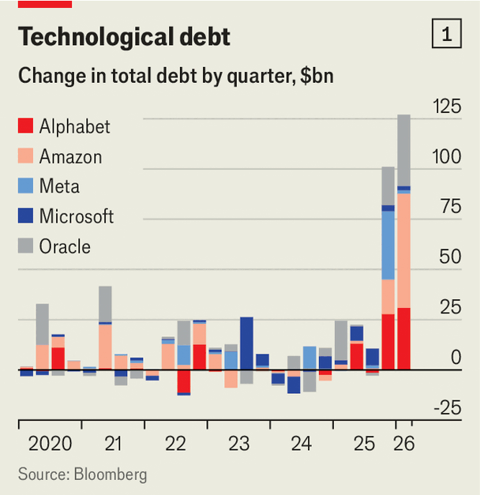
Source:The Economist.
The chart is presented as evidence of borrowing by large technology companies. Read alongside the financing argument, that matters because debt issuance can help fund investment when cash flow doesn't cover all planned spending. But borrowing is only one part of the picture: a chart of debt doesn't establish how much funding is for AI, what terms apply, or whether every announced project will go ahead. The useful signal is the broader change in funding sources, not a claim that borrowing alone determines the spending outcome.
Forecasts show free cash flow rising from 2028, but that remains a projection rather than an observed result. If cash flow does rise, it could provide more internal funding and ease the pressure to borrow. The timing matters: a forecast of later cash generation doesn't pay for spending undertaken in the meantime. For now, capex plans from four hyperscalers point to substantial spending.
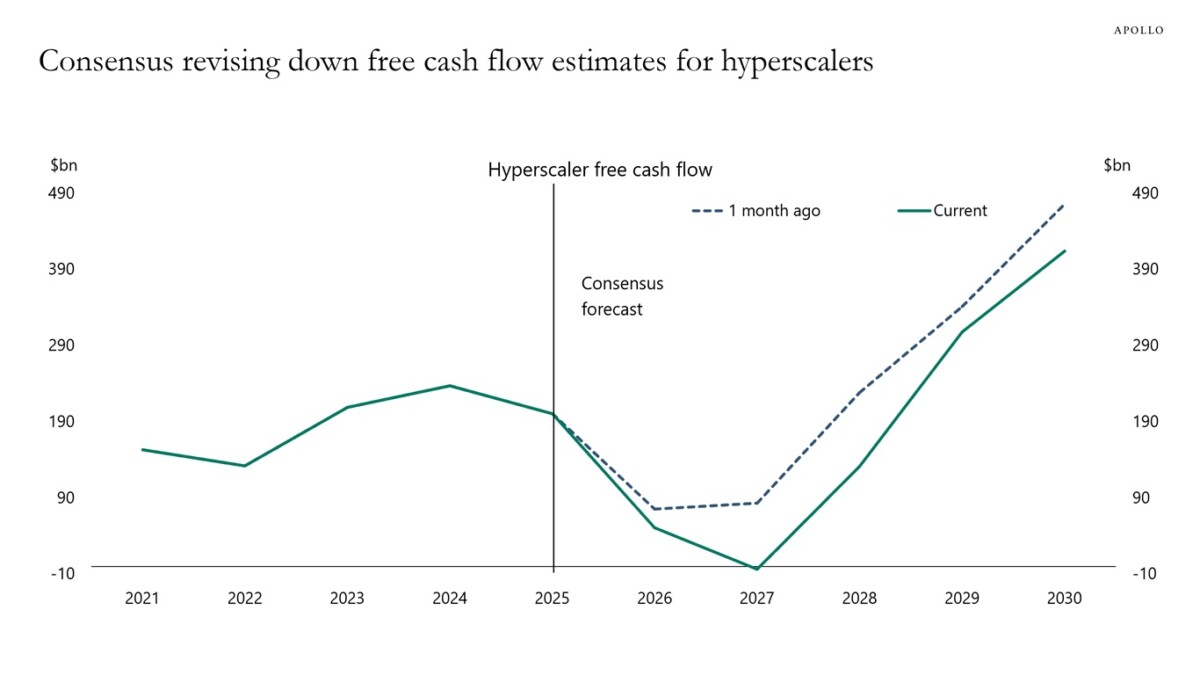
Source: Slok (July 28, 2026).
Capital expenditure, or capex, is spending on assets intended to support operations over time. For hyperscalers, the source links these plans to AI investment, but the chart alone can't tell us how quickly the spending will translate into useful capacity or revenue. Building infrastructure requires money before any future returns are established. That's why plans, cash flow forecasts, and actual financing should be read as related but distinct pieces of evidence.
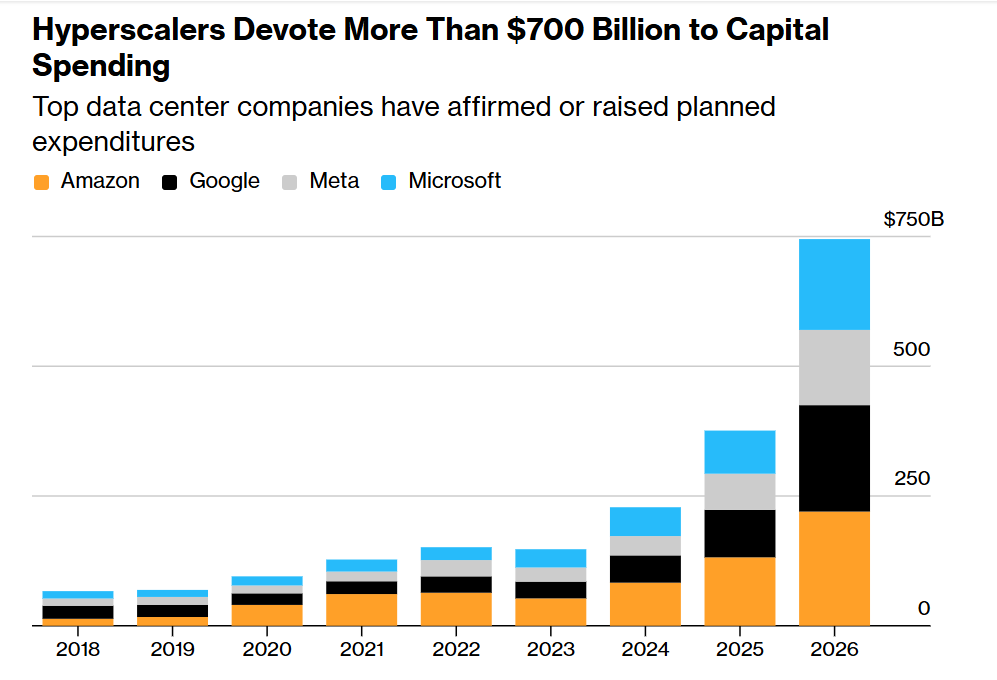
Source: Bloomberg (July 30, 2026).
Capex estimates can change as companies update their plans and as analysts revise expectations. The chart and its source offer a snapshot of those expectations; they aren't a guarantee of final expenditure. This is more significant than it looks: when several large companies are planning substantial outlays at once, their combined demand for funding can make financial conditions more relevant to the pace of investment. The source doesn't establish that higher yields have already forced a change in spending.
Why bond yields enter the investment decision
That shift makes financing costs more consequential. When internal cash covered investment, hyperscalers were largely insulated from rising bond yields in the sense that a change in market borrowing costs didn't directly raise the cost of funds they were using for each internally financed project. With external borrowing playing a bigger role, higher rates could curb their demand for finance and weigh on planned spending. The effect isn't automatic: companies can adjust funding sources, project timing, or the scale of their plans, and the source doesn't say which response they'll choose.
In general, higher borrowing costs make debt-financed projects more expensive to fund. A company comparing potential projects may then reassess whether expected benefits justify the added cost, especially when cash isn't available to cover the full investment. The same interest-rate move can have different effects across firms, depending on cash flow, borrowing needs, and the timing of spending. (And this is the part most people overlook.) A bond yield is one input into that decision, not a complete measure of the expected return on AI investment or of the company's ability to finance it.
If you're working in this space, the distinction to watch is between announced investment plans and the funding that supports them. A higher capex forecast signals intent, while borrowing activity and future cash flow help explain how that intent might be financed. Neither measure, by itself, confirms that planned projects will be completed on schedule. The numbers here are suggestive, not conclusive.
What the US capex estimate adds
Update, Aug. 2, 2026: Goldman Sachs estimates hyperscaler capex taking place in the US will total $581 billion in 2026.
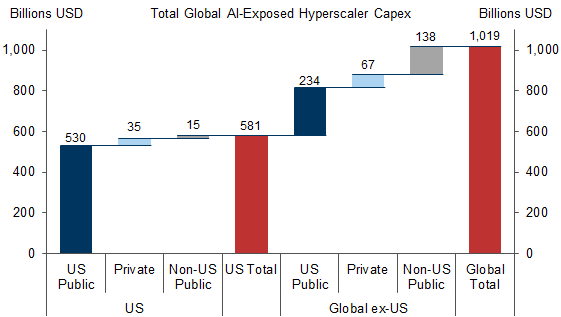
Source: GS (Aug. 2, 2026).
The estimate gives a sense of the scale attributed to US hyperscaler capex in 2026, but it's still an estimate, and the source doesn't specify here how the total is divided among companies or funding sources. Its value is in placing the financing discussion beside a large projected spending commitment. That said, a headline total doesn't show how much will be funded through cash flow, borrowing, or other sources, nor does it establish that higher yields will alter the estimate.
What to watch next
The central question is whether internal cash flow catches up with investment needs. The cited forecasts point to rising free cash flow from 2028, while the current account describes growing reliance on external finance and substantial capex plans. If that projection holds, the funding mix could become less dependent on borrowing later. If spending continues to require more external finance in the meantime, borrowing costs may have more influence over its pace.
And yet, the evidence here supports a measured conclusion. It shows a shift in financing conditions and plans, not a proven break in investment or a direct causal estimate of how yields will affect capex. Readers should keep the distinction between projections and realized cash flow in view as new figures arrive. For now, the financing channel deserves attention because it connects bond-market conditions to decisions about AI infrastructure spending.