U.S. consumer sentiment has recovered toward prewar levels, but the rebound still leaves a substantial gap against earlier benchmarks. The final University of Michigan reading and Conference Board confidence remain 2.2 to 2.4 standard deviations below their pre-Trump levels; Gallup’s confidence measure is 1.1 standard deviations lower. The direction has improved, but the distance from those reference points is still large.
What the measures show
The chart puts three consumer indicators on a common scale by subtracting each series’ average and dividing by its standard deviation over the period shown. That treatment makes their relative movements easier to compare, even though the underlying surveys ask different questions and don’t measure precisely the same thing. The University of Michigan and Conference Board readings are therefore useful as separate signals, not interchangeable estimates of a single confidence level.
The gap between the measures is meaningful. University of Michigan sentiment and Conference Board confidence sit farther below their pre-Trump benchmarks than Gallup’s measure does. That divergence suggests the rebound isn’t uniform across surveys, and readers should be cautious about treating any one series as a complete account of household attitudes.
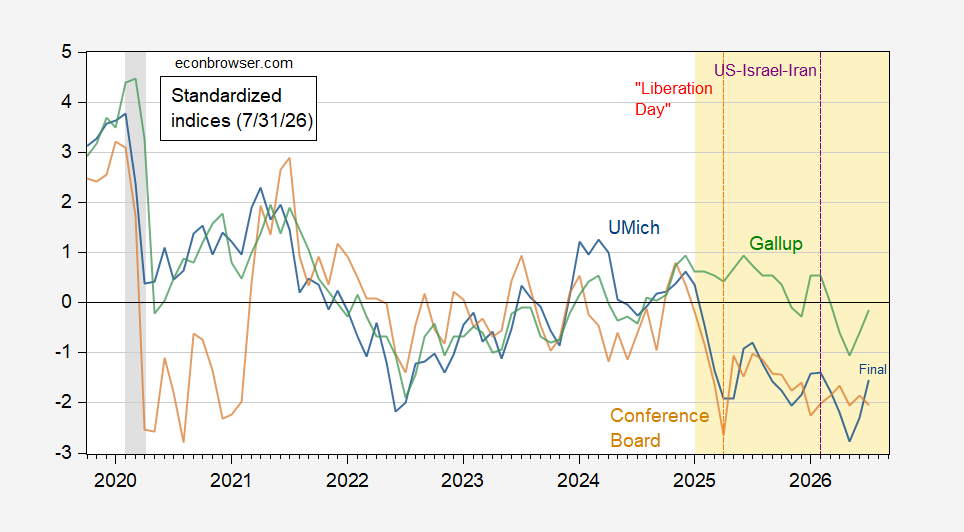
Figure 1: University of Michigan Economic Sentiment (blue), Conference Board Confidence Index (brown) and Gallup Confidence level (green), each demeaned and divided by its standard deviation for January 2021–February 2025. Orange dashed line marks “Liberation Day”; purple dashed line marks the start of the U.S.-Iran war. Source: University of Michigan, Gallup, Conference Board and author’s calculations.
Fuel costs and the rebound
Gas prices may help explain the improvement. The comparison shows that sentiment has risen during a period when fuel costs were lower, a relationship that fits a familiar household budget channel: gasoline is a frequent purchase, and changes at the pump are visible quickly. When prices ease, consumers may feel less pressure on the money available for other spending.
That said, the chart alone doesn’t establish that lower fuel costs caused the rebound. Sentiment can also respond to broader economic conditions and to how households interpret their own finances and the outlook. A visual overlap can point to a plausible connection, but it can’t isolate the effect of gasoline from those other influences.
(And this is the part most people overlook.) A lower fuel bill can improve the mood of consumers who drive regularly while doing little for households with different spending patterns. The same price movement won’t affect every consumer equally.
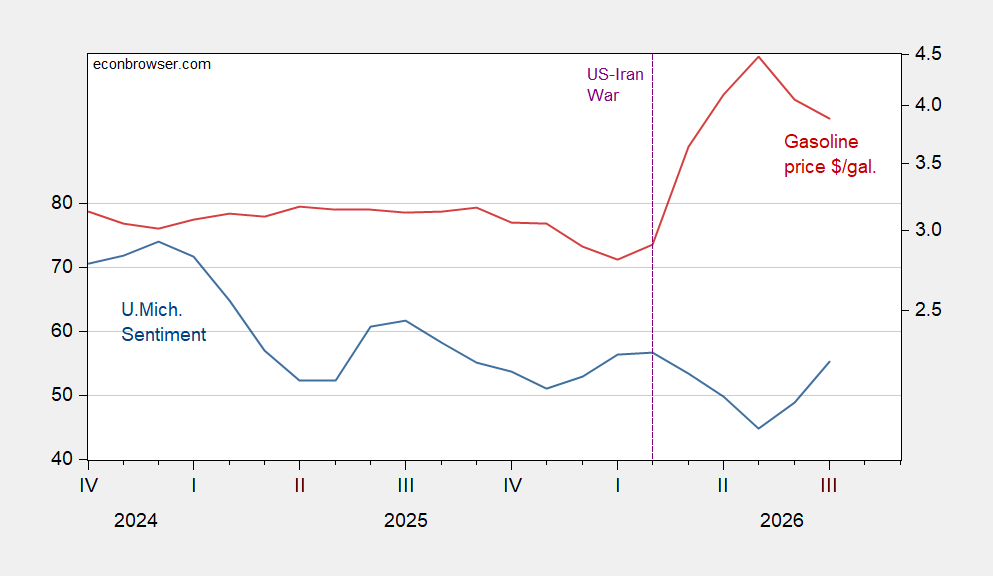
Figure 2: University of Michigan Consumer Sentiment (blue, left scale) and gasoline price in dollars per gallon (red, right logarithmic scale). Source: University of Michigan, EIA and author’s calculations.
Why the remaining gap matters
For businesses tracking consumers, the split across these benchmarks matters: the recent rebound is visible, but confidence remains well below its pre-Trump range. Sentiment readings can help frame how consumers view the economy, but they don’t directly reveal what households will buy or how much they’ll spend. A stronger reading may signal improving perceptions while leaving unanswered whether that change is broad enough to alter purchasing decisions.
If you're working in this space, the practical takeaway is to watch the direction of the measures alongside their distance from earlier benchmarks. The numbers here are underwhelming as evidence of a full recovery: one measure has moved closer, yet all three remain below the cited pre-Trump levels. That makes the rebound real, but incomplete.
For now, the charts support a measured reading. Sentiment has improved alongside lower gasoline prices, while the scale of the remaining gap and the differences among surveys argue against declaring the return complete. Still some distance to go.