The latest risk to U.S. employment growth may come from a smaller labor force, not weaker demand. That distinction matters: employers can have jobs to fill and customers to serve, yet still add fewer workers if people who currently do the work lose permission to remain employed. Work permit losses among immigrants could tighten staffing in sectors that have supported payroll gains, especially health care and social services.
A New York Times report says about 350,000 Temporary Protected Status recipients from Haiti and several other countries are expected to lose work permits in the first wave following a Supreme Court ruling. Roughly 190,000 Salvadoran beneficiaries could also lose status when it expires in September. Those figures describe potential exposure, not a count of workers who will necessarily leave a particular job or region. “For particular places and particular industries, tens of thousands of workers no longer able to legally work is going to be a very big hit,” said Alexander Arnon, director of policy analysis at the Penn Wharton Budget Model, which has analyzed the economic impacts of T.P.S. workers.
The employment effect depends on where affected workers live, what jobs they hold, and whether employers can find replacements. A national total can signal the scale of a change while obscuring the places where it may be felt most sharply. The impact may be uneven even within a single sector: a broad industry can look adequately staffed in aggregate while individual employers struggle to cover shifts or maintain services.
Sector exposure matters
These potential losses come amid the administration’s broader crackdown on migrants. Health care and social services, along with construction, face notable exposure. Health care and social services have accounted for a substantial share of employment growth over the past year, so staffing constraints in those fields could weigh on the pace of payroll gains.
That exposure reflects a basic feature of labor-intensive work: services depend on people being available to perform them, and vacancies can be difficult to absorb when employers cannot quickly substitute equipment or reorganize tasks. In health care and social services, staffing limits can constrain how many appointments, cases, or shifts an organization can handle. Construction faces a different set of operating conditions, but it too relies on workers being available at the right time and place for projects to proceed.
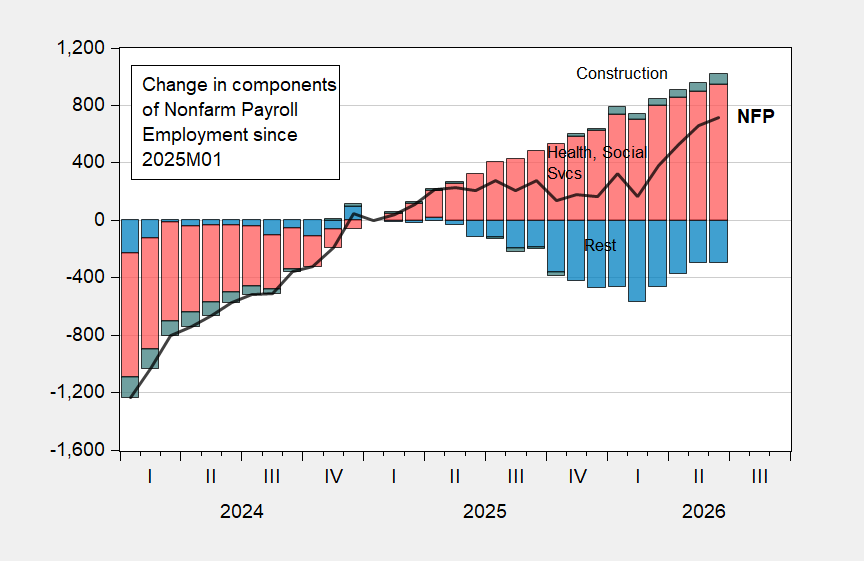
Figure 1: Change since 2025M01 in total nonfarm payroll (NFP) employment (bold black line), health care and social services employment (salmon bar), construction (green bar), and the rest of NFP (blue bar), in thousands, seasonally adjusted. Source: BLS and author’s calculations.
The chart tracks how much recent payroll growth has depended on these sectors. It separates health care and social services, construction, and the rest of nonfarm employment, making the composition of growth easier to see than a single headline payroll figure would. The separation matters because a strong total can coexist with weakness in other industries when a small number of sectors contribute a large share of new jobs.
If work permits lapse at the scale described, labor supply could become a more visible constraint on employment growth. That doesn’t establish that payrolls will fall: employers may recruit other workers, adjust schedules, or leave positions unfilled. But each response has limits, and the speed of any adjustment matters. A vacancy that remains open can slow hiring even when demand for the underlying service remains intact.
What the payroll figures can and can’t show
Payroll data count jobs, but they don’t by themselves explain why hiring changes. If job growth cools, weaker demand is one possible explanation; a tighter supply of available workers is another. The distinction can be hard to pin down from headline totals alone, especially when the change is concentrated in particular occupations or communities.
Timing also complicates the picture. The reported permit losses are expected in waves, with the Salvadoran status expiration described as occurring in September. Employers may anticipate disruptions before they appear in monthly employment data, while any actual effect could emerge gradually as permits lapse and staffing decisions change. That makes the figures a reason to watch the composition of payroll growth, not proof of a specific near-term outcome.
This is more significant than it looks: the same employment total can tell a different story depending on whether businesses are hiring less because customers have pulled back or because fewer workers are available. And this is the part most people overlook: a labor supply constraint can limit output even when demand hasn’t weakened. The fragment is simple. Fewer available workers.
Implications for employers and readers
For employers in exposed sectors, the immediate question is operational: can open roles be filled, and can existing staff absorb additional work without disrupting service? Similar workforce disruptions often affect locations and job categories unevenly, so industrywide data may not reveal which employers face the greatest pressure. If you're working in this space, local staffing conditions may be more informative than the national payroll headline.
For readers assessing employment growth, the useful signal will be whether hiring changes cluster in the sectors identified here and whether the broader labor market shows signs of weaker demand at the same time. No single chart can settle that question. The figures in the report establish a substantial potential pool of affected workers, while the chart places sector growth in context; neither alone measures how many jobs will actually be lost or how employers will respond.
That said, the risk is clear enough to monitor. If staffing constraints become binding in sectors that have contributed substantially to recent job gains, aggregate payroll growth could slow without a corresponding collapse in demand. The scale and timing remain uncertain, and the effects may be concentrated. The next reading of employment growth will matter most when viewed alongside the sectors doing the hiring and the availability of workers to fill those roles.