China’s second-quarter growth undershot expectations, exposing the strain in an economy increasingly dependent on exports while domestic demand remains weak. GDP rose 4.3% year over year, down from 5.0% in the first quarter and below both the 4.5% market consensus and Goldman Sachs’ forecast. Growth averaged 4.7% in the first half, within China’s 4.5%–5.0% annual target range. That half-year average gives officials a measure of progress toward the target, but it doesn’t erase the quarter’s slowdown or explain how much of the expansion is being carried by external demand.
The distinction matters because headline growth compresses very different conditions into one figure. Export growth can support production even as households spend cautiously and investment weakens. A target-range average may therefore coexist with pressure in parts of the economy that matter to consumers and businesses. The second-quarter result points to that unevenness, though it doesn’t by itself establish how persistent it will be.
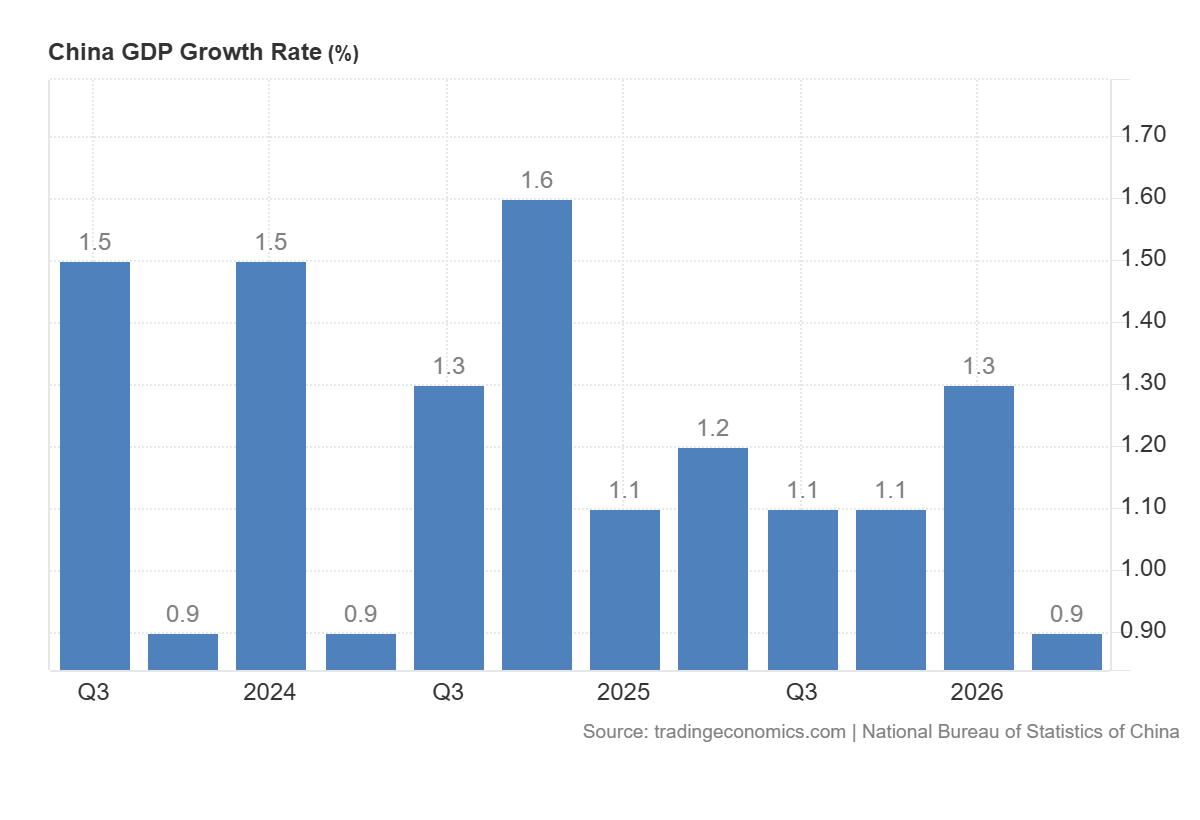
The quarter-on-quarter picture was less weak: the National Bureau of Statistics estimated seasonally adjusted growth at 0.9%, not annualized, versus 1.3% in Q1. That matched market and Goldman expectations. Goldman said the gap between weaker annual growth and an in-line quarterly result may reflect revisions to historical sequential growth estimates. The two measures answer different questions: year-over-year growth compares the quarter with the same period a year earlier, while the sequential figure tracks the change from the immediately preceding quarter after seasonal adjustment.
That difference complicates quick readings of the data. An in-line quarterly figure suggests activity continued to expand at a pace forecasters anticipated, while the year-over-year comparison shows a sharper loss of momentum against the prior year. If historical sequential estimates have been revised, the apparent gap may partly reflect the measurement baseline. The release offers reasons for caution, not a clean verdict on whether the slowdown is accelerating.
Exports offset only part of the domestic weakness
Export strength hasn’t been enough to compensate for softer activity at home. Exports jumped 27% in June, while fixed-asset investment fell 5.7% in the first half and retail sales growth remained stagnant, according to the Wall Street Journal. These indicators describe different parts of the economy, but together they show why strong shipments alone don’t settle the question of domestic demand: investment is contracting, and household spending hasn’t supplied a clear counterweight.
Exports can sustain factory output and help cushion a domestic slowdown, but they don’t automatically revive confidence or spending at home. The reliance also leaves growth more exposed to whether overseas buyers keep absorbing Chinese goods. The figures don’t show that export demand has failed; they show that its strength hasn’t prevented the broader economy from slowing.
The property slump continues to weigh on household wealth and sentiment. Property investment dropped 18% in the first half from the same period in 2025. Manufacturers are also looking abroad for demand: monthly car exports exceeded 1 million in June for the first time, even as domestic car sales fell 23% for a ninth consecutive month. NPR also reported on the slowdown.
Property and cars make the split especially visible. A prolonged property downturn can affect household perceptions of wealth and willingness to spend, while weaker car sales point to trouble converting production into purchases at home. Exporting more vehicles may keep manufacturers busy, but it doesn’t answer whether domestic buyers will return. This is more significant than it looks: production and sales can diverge for a time, leaving headline industrial strength a poor guide to household confidence.
Official growth estimates remain contested
Some analysts argue that China’s economy may be weaker than official figures suggest. One Wall Street Journal opinion piece questions the data, while Scissors at the American Enterprise Institute has raised questions about the first-half GDP deflator. Those challenges bear on how the figures should be interpreted, but they aren’t enough on their own to replace the official estimate with a different measure of activity.
GDP deflators matter because they separate changes in the value of output from changes in its volume. If the deflator is disputed, the resulting real-growth estimate can also be contested. That’s a reason to compare GDP with other indicators and to pay attention to revisions, not a basis for treating a particular alternative growth rate as established. The available evidence in this account leaves the scale of any measurement problem unresolved.
China’s apparent ability to manage a shortfall in oil imports is consistent with the possibility of slower growth, but it isn’t enough to establish a severe contraction. The San Francisco Fed’s China Cyclical Activity Tracker, which uses Chinese import data, pointed to slower growth than official figures through 2025 Q4, based on data accessed July 17. A broader assessment is needed before drawing stronger conclusions. Import-based measures offer a useful cross-check, but any single indicator has limits; changes in imports can reflect several forces and shouldn’t be read as a direct substitute for GDP.
What the slowdown could mean for the growth outlook
The IMF’s July World Economic Outlook projected 2026 Q4-over-Q4 growth of 4% for China and 2.3% for the United States, with world growth at 2.9%. As an accounting illustration, using nominal GDP weights in U.S. dollars, Chinese growth of 2% would lower the implied global rate to 2.57%. The central question is whether domestic weakness will deepen enough to pull growth materially below the official path.
That calculation is illustrative, not a forecast. It shows how a lower Chinese growth rate could affect a global aggregate, but the result depends on the assumed rate and the weighting method. It also says little about how the slowdown would be distributed across industries or trading partners. The IMF projection and the lower-growth scenario serve different purposes: one records a forecast, the other demonstrates sensitivity to a changed assumption.
Here’s the thing: the evidence points to a clear imbalance, but not yet to a definitive account of how far it will go. If you’re working in this space, the useful signals to watch are whether retail demand stabilizes, whether investment remains under pressure, and whether export strength continues to carry production. None of those measures alone can resolve the dispute over official growth estimates.
And yet. A slower official figure, weak domestic indicators, and competing assessments of the data all point toward the same practical uncertainty: how much resilience exports can provide while demand at home remains subdued. The numbers here are underwhelming. The next reading of activity will matter because it can help distinguish a temporary soft patch from a more persistent shortfall—without settling the measurement debate on its own.